



Google Review Card vs QR Stand vs Sticker: What Works Best?
A Google review card, a printed QR stand, and a window sticker all aim at the same goal—more reviews. Here is an honest comparison of conversion, durability, and cost to help you pick.
By VIPKART · Published June 20, 2026 · 9 min read
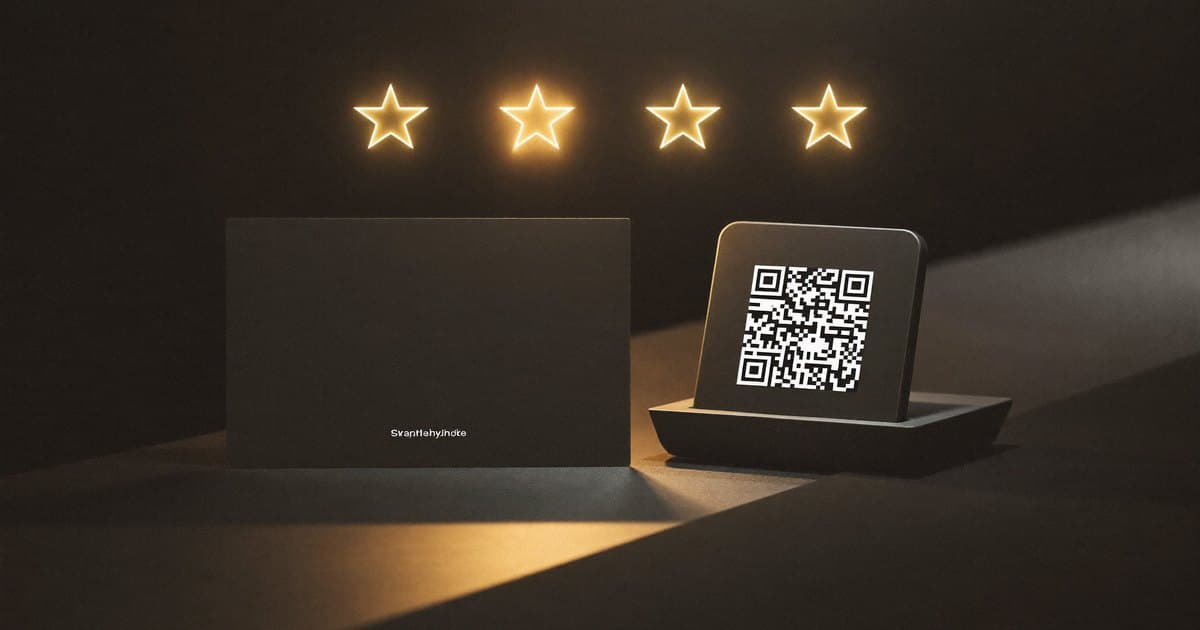
You already know reviews matter. You have probably already searched for a way to collect more of them, which is how you ended up comparing the three formats most businesses reach for: a tap-enabled review card, a printed QR stand on the counter, and a sticker in the window or on the till. They all promise the same outcome—a customer ends up on your Google review page—but they do not deliver it equally.
The difference is not cosmetic. It shows up in how many customers actually finish a review, how long the thing survives daily use, and what it quietly costs you over a year. This guide compares all three honestly, including where a sticker beats a card and where a QR stand quietly leaks customers you thought you were capturing. By the end you will know which format fits each spot in your business—and why, for the personal handoff that converts best, a Google review card tends to win.
The three formats, side by side
Before the trade-offs, it helps to be precise about what each format actually is, because the marketing around them blurs the lines.
A Google review card is a physical card, roughly the size of a business card or a small coaster stand, with an NFC chip embedded inside and usually a QR code printed on it as backup. The customer taps it with their phone—or scans the code—and your review page opens. It is built to be handed over, tapped, and handed back, which makes it the natural tool for a one-on-one moment at the desk or the table.
A QR stand is a printed card or acrylic block that displays a QR code and sits on a surface—the counter, a restaurant table, the reception desk. There is no chip. The customer has to open their camera, frame the code, and tap the notification. It works at a distance and serves many people without staff involvement, but every interaction depends on the customer choosing to scan.
A window or till sticker is a printed QR code (sometimes with an NFC layer) stuck to glass or a flat surface. It is the cheapest and most permanent option, visible to anyone passing or paying, but it is also the most passive: nobody hands it to anyone, and it competes with everything else in a customer's eyeline.
All three point to the same destination. The question is how reliably each one gets a real human all the way there.
Conversion: which one actually gets reviews?
This is the metric that matters most, and it is the one the price comparison sites tend to skip. A cheaper format that collects half as many reviews is not cheaper at all.
Why the tap converts
The reason a review card outperforms is friction—or rather, the lack of it. With a QR code, the customer has to take three deliberate actions before they even see your page: open the camera app, hold the phone steady enough to frame the code, and tap the notification that appears. Each of those steps loses a few people. Someone whose hands are full, whose camera defaults to selfie mode, or who simply cannot be bothered to aim, drops out before they start.
A tap removes all of that. The customer holds their phone near the card, a notification appears, they tap it, and your review form loads. There is nothing to aim, nothing to frame, and—crucially—a small element of novelty that makes people want to try it. We covered the mechanics in depth in what is a Google review NFC card, but the short version is that fewer steps mean fewer drop-offs, and the tap has the fewest steps of any format.
Why the handoff converts more than the display
There is a second, quieter advantage that has nothing to do with technology. A review card is handed over by a person. A QR stand and a sticker just sit there.
The single biggest driver of a posted review is being asked at the right moment—right after a good meal, a fresh haircut, a smooth checkout. A staff member offering a card with one warm sentence ("we'd love your feedback if you have a moment") captures that peak far more reliably than a stand the customer has to notice, interpret, and act on by themselves. A QR stand only works if the customer is already motivated enough to scan unprompted, which most satisfied-but-busy people are not. The card turns a passive display into an active invitation.
Where stickers and stands still pull their weight
None of this means the printed formats are useless. A sticker in the window or a stand on a self-service counter catches the people a staff member never reaches—the customer who slips out while you are with someone else, or the regular who would feel awkward being handed something. They run silently, all day, for nobody's attention. Think of them as the safety net under the card, not a replacement for it. The honest ranking on raw conversion: card first, stand second, sticker third—but the gap narrows when there is no one available to make the ask.
Durability: what survives daily use
A review tool lives in one of the harshest environments in your business—the counter, the till, the table—where it gets touched, spilled on, wiped down, and knocked around dozens of times a day. Longevity is a real cost line, not a footnote.
A window sticker is the most permanent in one narrow sense: stuck to glass, it does not move and cannot be pocketed. But it also cannot be cleaned aggressively without lifting at the corners, it fades in direct sun over a year, and a printed QR code that scuffs or peels stops scanning entirely. Once it degrades, your only option is to reprint and re-stick.
A printed QR stand is more robust if it is acrylic rather than card, but the QR code itself is still just ink on a surface. Coffee rings, greasy fingers, and the daily wipe-down slowly erode print contrast, and a low-contrast QR code is a QR code that fails to scan. Cardboard table tents fare worst of all in a busy restaurant.
A well-made review card is the most durable of the three in practice, because its core function does not depend on a printed surface at all. The link lives on the chip inside, sealed against spills and wear. The card can be wiped, dropped, and handled thousands of times, and the tap still works even if the printed QR backup eventually scuffs. A premium card in metal or thick PVC—the kind we break down in NFC business card materials compared—is built to survive years of being handed across a counter. Durability is one of the quiet reasons the card's higher upfront price evens out.
Cost: the real one-year picture
Stickers and printed stands win the sticker price. A QR sticker costs almost nothing, and a printed stand is a few euros. A quality NFC review card costs more upfront—there is a chip inside it, after all. If you stop the comparison at the shelf price, the printed formats look like the obvious choice.
But the meaningful number is cost per review collected over a year, and that reorders things quickly.
- Stickers are cheap to buy but fade and peel, so you reprint. More importantly, their low conversion means you are paying very little to collect very few reviews—the cost per actual review can be high precisely because the format converts so poorly.
- Printed QR stands sit in the middle: affordable, reasonably durable in acrylic, but still bottlenecked by the scan friction that costs you customers at the moment of the ask.
- Review cards cost more on day one and then essentially nothing after that. A good card is a one-time purchase with no per-tap or per-review fee, it lasts for years, and it converts more of the people it reaches. Spread the upfront cost across the higher volume of reviews it collects over twelve months, and the cost per review often comes out lowest.
One warning that applies across all three: watch for recurring subscription fees. Some review tools—cards and stands alike—charge a monthly fee just to keep the link alive, which quietly turns a one-time purchase into a lease. A well-built review card does not need one. The chip holds your link permanently, and a good platform lets you re-point that link from a dashboard without ever paying to keep the card working. We unpack the underlying tap-versus-scan economics further in NFC vs QR code business cards.
A quick decision guide
The truthful answer is that the best businesses do not pick one format—they layer them. Each covers a different moment.
Choose a review card when
There is a human handoff at the heart of the interaction: a server closing out a table, a stylist at the desk, a clinician walking a patient to reception, a hotel checking a guest out. Any time a staff member can offer the review personally, the card converts best by a wide margin. It is also the right call when you want a single tool that survives years of daily handling and carries your brand in the hand.
Choose a QR stand when
The interaction is self-service or high-volume, and staff cannot hand something to everyone—a fast-casual counter, a waiting area, a hotel breakfast room. A stand catches the motivated customer who is happy to scan on their own and does not need a personal invitation to do it.
Choose a sticker when
You want a permanent, zero-effort presence in a spot people linger or pass: the front window, the glass by the till, the back of a restroom door. Stickers are the safety net—cheap, always-on, and good at catching the customer your staff never got to. They are weakest as a primary tool and strongest as a backstop.
The combination most businesses land on
A review card for the personal handoff, a stand or sticker as the always-on backup for everyone the card does not reach. The card does the heavy lifting on conversion; the printed formats sweep up the rest. If you run several locations or a team that each needs their own card, the logic of provisioning cards at scale is the same one we cover in digital business cards for teams.
Staying within Google's rules, whichever you choose
The format does not change the rules, and the rules are worth repeating because breaking them risks your listing. Whether you tap, scan, or stick:
- Ask everyone, not just the happy ones. Google prohibits "review gating"—steering only satisfied customers to the review page while diverting unhappy ones elsewhere. Offer the card, stand, or sticker to all customers equally.
- Never buy or incentivize reviews. A discount in exchange for a review violates Google's policies. Every format's only legitimate job is to make a genuine review effortless, not to manufacture one.
- Offer, don't pressure. The lightest touch converts best. This is where the card has an edge—a one-sentence offer feels natural, while a customer scanning a stand never feels pushed in the first place.
For the broader playbook on building a steady, policy-safe stream of reviews across all of these touchpoints, how to get more Google reviews goes deeper, and Google reviews for restaurants covers the hospitality specifics where timing the ask matters most.
Frequently asked questions
Is a review card really better than a QR stand?
For the moment a staff member can hand something over, yes—consistently. The tap removes the camera-aiming friction a QR scan demands, and the personal handoff captures the peak of satisfaction better than a passive display. For unattended, self-service spots, a QR stand is the more practical choice. They are complementary tools, and most businesses get the best results using both.
Do I still need a QR code if I have an NFC card?
It is worth having both, which is why quality review cards print a QR code on the card itself as a backup. The tap covers the overwhelming majority of phones, and the QR code reaches the rare cases—an older device, NFC switched off, or a customer who simply prefers to scan. Between tap and scan, you reach effectively everyone.
Are stickers a waste of money?
No—they are just the wrong tool to rely on alone. A sticker is cheap, permanent, and genuinely useful as an always-on backup in a window or by the till, catching customers your staff never reached. It underperforms as your primary review tool because nobody hands it over and it competes with everything else in view. Treat it as a safety net, not the main net.
Which format is the most durable?
A well-made review card, in practice. Its function lives on the sealed chip inside rather than on a printed surface, so spills, wipe-downs, and daily handling do not stop it working. Printed QR codes on stands and stickers slowly degrade as the ink scuffs, fades, or peels—and a degraded QR code stops scanning. A premium metal or thick PVC card is built to last years.
What does it actually cost over a year?
Stickers win on shelf price and stands sit in the middle, but a review card usually wins on cost per review collected. It is a one-time purchase with no per-tap fee, it lasts for years, and it converts more of the people it reaches—so spread across the higher volume of reviews, the real cost per review tends to be lowest. Avoid any format that charges a recurring subscription just to keep the link alive.
Pick the format that fits the moment
There is no single winner, but there is a clear hierarchy. For the personal handoff that drives the most reviews, a Google review card converts best and lasts longest. A QR stand earns its place at self-service counters, and a sticker is a cheap, permanent safety net in the window. The businesses that climb the rankings usually run a card for the moments that matter and a printed backup for the rest.
If you want the format that captures the peak of a satisfied customer's goodwill before it fades, take a look at the VIPKART review card. One tap takes them straight to your Google review page—no app, no monthly fee, and nothing to aim a camera at—so more of the reviews you have already earned actually get posted.
Ready to make a card people keep?
Tap to share, save in seconds, and update your details for life.
Explore VIPKART